The Ultimate Guide to Creating Supplement Dosing Schedules
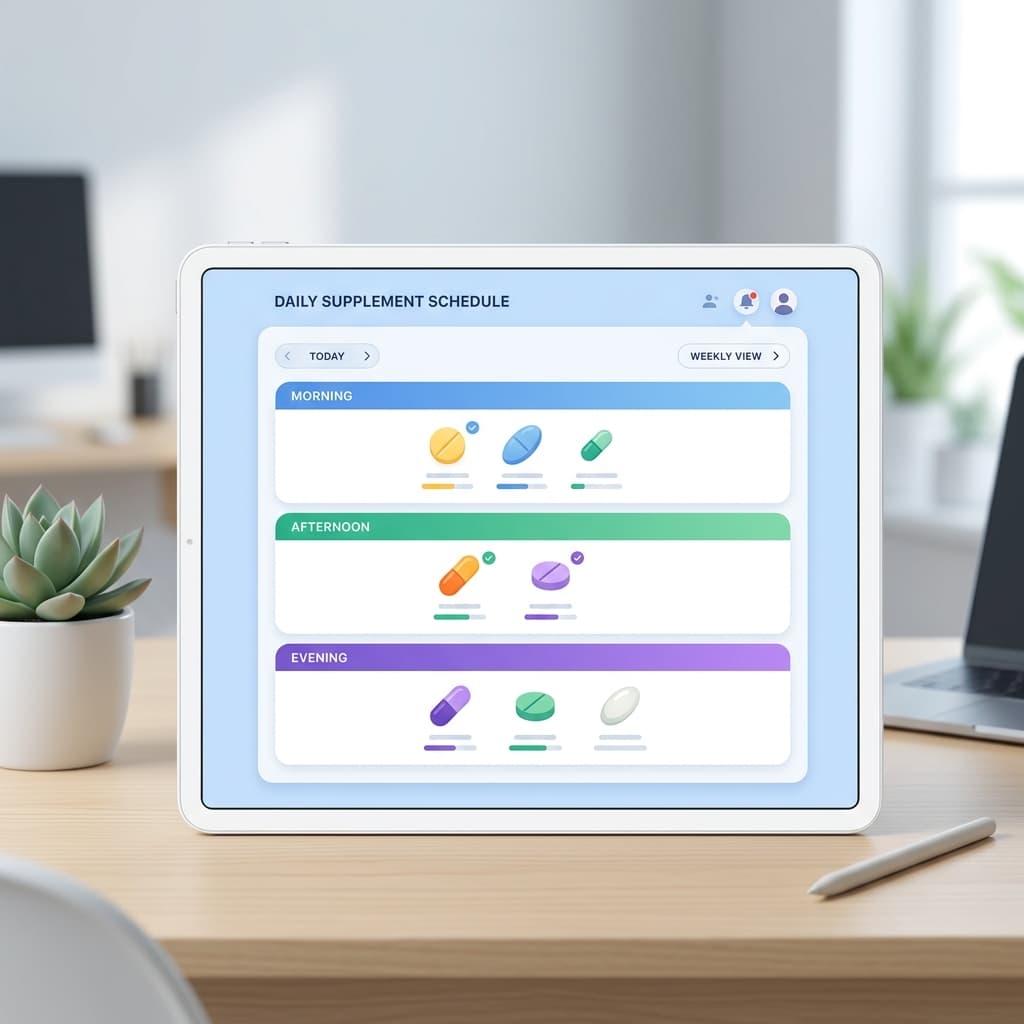
A supplement dosing schedule is a structured plan that tells your customer exactly which supplements to take, how much to take, and when to take them throughout the day. It replaces vague label instructions like "take 1-2 capsules daily" with specific, timed guidance that accounts for nutrient interactions, absorption science, and individual needs. If you sell supplements and you're not providing one, you're leaving customer results — and retention — on the table. This guide covers everything you need to build dosing schedules that actually work, whether you're a solo practitioner or a brand shipping thousands of orders per month.
What is a supplement dosing schedule?
A supplement dosing schedule is a time-based protocol that organises supplement intake across a customer's day. Rather than a single instruction on a bottle, it maps each product to a specific window — morning, midday, or evening — with notes on food pairing, interactions to avoid, and dosage amounts tailored to the individual. Think of it as the difference between handing someone a bag of ingredients and handing them a recipe. The ingredients might be identical, but the recipe produces results. A well-built dosing schedule typically covers four things: what to take, when to take it, how to take it (with food, on an empty stomach, with fat), and what not to combine. For brands managing multiple SKUs, it also serves as a coordination layer — ensuring that a customer buying three or four products from you gets a single, coherent plan instead of three conflicting label instructions.
Why generic bottle labels fall short
The standard supplement label is designed for regulatory compliance, not customer success. "Take 2 capsules daily with food" tells a customer almost nothing about optimal use. It doesn't say whether morning or evening matters. It doesn't mention that their calcium supplement is blocking the iron they're also taking from the same brand. It doesn't account for the fact that their fat-soluble vitamin D is essentially wasted when taken on an empty stomach. The result is predictable: customers take everything at random times, experience mediocre results, and quietly stop reordering. Industry data consistently shows that 40-60% of first-time supplement buyers don't come back. When brands investigate why, the answers are almost always the same — "I couldn't tell if it was working" and "I kept forgetting." Both problems trace directly back to the absence of a clear dosing plan. Labels are legally required. Dosing schedules are what actually help people.
The science of timing, absorption, and nutrient interactions
Supplement timing isn't wellness folklore — it's grounded in chronobiology and absorption science. Your body's digestive enzymes, hormone levels, and nutrient transport systems all follow predictable daily patterns. Cortisol peaks in the morning, making it the ideal window for energising supplements like B-vitamins and CoQ10. Parasympathetic activity rises in the evening, which is why magnesium glycinate and ashwagandha perform best before bed. Fat-soluble vitamins (A, D, E, K) require dietary fat for absorption — taking vitamin D on an empty stomach can reduce bioavailability by up to 70%. Meanwhile, nutrient interactions can make or break a protocol. Calcium and iron compete for the same absorption pathways; taking them together can cut absorption of both by half. Vitamin C boosts iron absorption by 200-300%. Vitamin K2 directs calcium into bones instead of arteries. Zinc depletes copper over time if not balanced. These aren't edge cases — they're the basic mechanics of how nutrients work in the body. A dosing schedule that ignores them is a dosing schedule that underperforms. For a deeper look at timing science, see our post on why supplement timing matters more than you think.
Step-by-step: How to build a dosing schedule from scratch
Building a dosing schedule doesn't require a nutrition degree, but it does require methodical thinking. Here's the process that works for both solo practitioners and larger brands. First, catalogue every product with its exact serving size, active ingredients, form factor (capsule, powder, liquid), and any special instructions. This is your source of truth. Second, assign each product to a timing window. Energising ingredients go to morning. Calming or recovery-focused ingredients go to evening. Anything requiring fat goes with a meal. Anything requiring an empty stomach gets placed 30 minutes before a meal or at bedtime. Third, check for conflicts. Separate competing minerals by at least 2-4 hours. Pair synergistic nutrients together — vitamin D with K2, iron with vitamin C. Flag any potential interactions with common medications. Fourth, add context. Don't just say "morning" — say "with breakfast, alongside something containing fat." Don't just say "2 capsules" — tell the customer what to expect in the first 2-4 weeks and when full effects typically appear. Fifth, personalise where possible. Adjust dosages for body weight, activity level, or specific health goals. Even small personalisation — like noting "if you train in the evening, shift your magnesium to 30 minutes post-workout" — signals expertise and builds trust. Our guide on creating the perfect supplement schedule covers the personalisation layer in more detail.
Tools and software for creating schedules at scale
If you're creating schedules for a handful of private clients, a spreadsheet can work. But the moment you're serving dozens or hundreds of customers, manual schedule-building becomes a bottleneck. You need software that lets you define your product catalogue once, build reusable schedule templates, personalise per customer, and deliver the finished schedule in a format customers will actually use. The key requirements for any scheduling tool are: a product database with timing and interaction rules built in, the ability to generate clean, branded schedules quickly, a delivery format that customers can access anytime (not a PDF they'll lose), and the flexibility to update schedules as products or protocols change. Some brands try to cobble this together with Notion templates, Google Docs, or Canva PDFs. These work in the early stages, but they don't scale — and they create a maintenance headache as your product line grows. Purpose-built tools eliminate the manual work and ensure every schedule follows your interaction rules automatically.
How top brands deliver schedules to customers
The delivery mechanism matters as much as the schedule itself. The best supplement brands have moved away from static PDFs and printouts toward interactive, always-accessible formats. The reasoning is simple: a schedule only works if the customer actually looks at it. Top-performing brands include a link to the customer's personalised schedule in their order confirmation email, their post-purchase follow-up sequence, and on their account page. Some embed it directly in their Shopify or WooCommerce store. The schedule is branded, mobile-friendly, and available whenever the customer needs it — no digging through email attachments or filing cabinets. The brands seeing the highest retention rates also use the schedule as a touchpoint. A follow-up email at day 14 saying "you should be starting to notice improved sleep quality around now — here's your schedule if you need a refresher" keeps customers engaged through the critical window where most people drop off. For a look at how common dosing errors undermine these efforts, our breakdown of common supplement dosing mistakes is worth reading alongside this guide.
A supplement dosing schedule is the single highest-leverage tool a supplement brand can offer its customers. It turns a bottle of capsules into a guided protocol. It turns a first-time buyer into a repeat customer. And it turns a generic product experience into something that feels personal, expert, and trustworthy. The science, the business case, and the customer demand are all pointing in the same direction: brands that provide structured dosing guidance win. Plandule gives you the infrastructure to build, personalise, and deliver professional dosing schedules at scale — so every customer gets a plan, not just a product.